How AI Reinvents Supply Chain Stability and Logistics Execution
Today's supply chains are far from quiet, stable systems running in the background. They face constant pressure from shifting demand, shipping delays, workforce gaps, and worldwide unpredictability. When something goes wrong, conventional tools are slow to respond. That's where AI comes in—not just as a basic automation layer, but as the “intelligent brain” that lets supply chains reason, anticipate, and adjust on the fly.
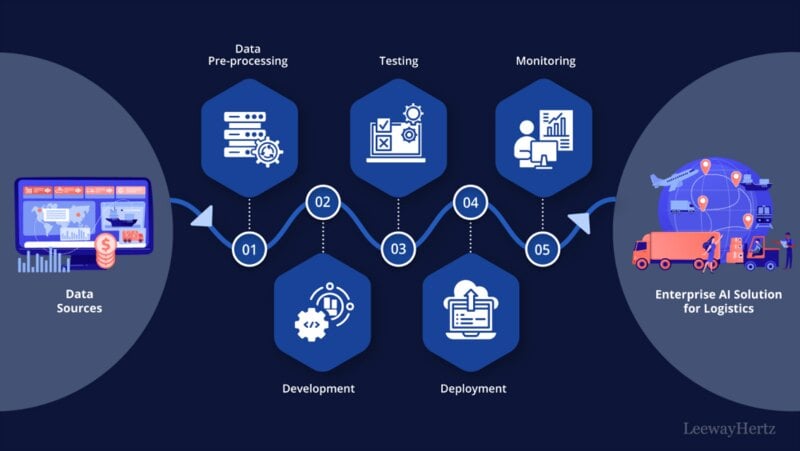
Here, we examine how AI is changing supply chain decisions in disruption management, inventory planning, and logistics execution, and why more companies are turning to AI-driven systems to remain resilient and competitive.
AI as the "Intelligent Brain" of Modern Supply Chains
Every day, supply chains produce enormous amounts of data. Order records, supplier updates, shipment tracking, warehouse activity, and customer signals keep arriving all the time. The real challenge isn't the volume of data—it's converting that data into fast, well-founded decisions.
AI acts as a central intelligence layer, joining those data flows, spotting patterns that are hard for people to detect, and suggesting or carrying out actions at a large scale.
AI-powered supply chains go beyond static rules or historical averages. They are:
-
Always learning from fresh data
-
Running thousands of scenarios at the same time
-
Using probability-based predictions instead of rigid assumptions
That shift moves supply chains from merely reacting to proactively adapting and improving themselves.
Cost Efficiency and Predictive Intelligence
Why Cost Control Alone Is Not Enough
Conventional cost-cutting tends to focus on squeezing suppliers or trimming safety stock. Those tactics work fine when conditions are stable, but they tend to fall apart in uncertain times. A sudden disruption can erase short-term savings and leave lasting harm.
AI takes a different angle on cost efficiency. It weighs risk-adjusted cost, balancing savings against dependability and resilience.
How AI Delivers Predictive Intelligence
AI models combine historical figures with real-time inputs like:
-
Supplier performance patterns
-
Shipping and transit delays
-
Changes in market demand
-
Outside conditions such as weather and geopolitical risk
When these inputs are combined, AI systems can foresee issues before they show up in normal reports.
Some of the main benefits are:
-
Early alerts about possible supply shortages
-
Better sourcing decisions grounded in risk likelihood
-
Ongoing cost optimization rather than fixed yearly plans
Example: Predictive Cost Optimization
| Category | Conventional Method | AI-Based Method |
|---|---|---|
| Supplier selection | Cheapest option | Optimal cost-risk-reliability mix |
| Transportation planning | Set routes | Live route and mode optimization |
| Risk response | Reactive | Proactive |
| Cost forecasting | Yearly budget | Rolling scenario forecasts |
AI can't remove uncertainty altogether, but it cuts down surprising events by swapping guesswork for data-driven foresight.
Balancing Inventory with Safety Stock Optimization
The Inventory Dilemma
Inventory management is at the heart of most supply chain problems. Holding too much stock ties up money and raises storage expenses. Holding too little triggers stockouts, lost sales, and weakened customer loyalty.
Standard safety stock calculations lean a lot on averages and past variability. In unstable environments, those assumptions no longer hold.
How AI Redefines Inventory Planning
AI-based inventory systems keep tracking:
-
Demand fluctuations across regions and channels
-
How dependable supplier lead times are
-
Seasonal and promotional impacts
-
Live sales and order trends
Instead of producing a single fixed safety stock figure, AI updates inventory targets as conditions change.
With AI-driven inventory optimization, businesses can:
-
Cut surplus stock without raising stockout risk
-
Match inventory levels to real customer behavior
-
Respond quicker to demand surges or drops
Practical Outcomes of AI Inventory Optimization
-
Reduced working capital needs
-
Higher service levels
-
Tighter alignment between plans and execution
Inventory Strategy Comparison
| Inventory Area | Conventional Planning | AI Planning |
|---|---|---|
| Safety stock | Fixed set amount | Adaptive, data-driven buffer |
| Demand forecast | Occasional updates | Ongoing learning |
| Regional differences | Usually overlooked | Completely considered |
| Response time | Delayed | Near real-time |
When inventory is handled as a living system instead of a fixed goal, AI supports better trade-offs between cost and service.
Optimizing Logistics Routes and Warehousing Operations
Logistics Complexity Is Increasing
Logistics has grown more complicated because of:
-
Expanding e-commerce and demands for faster delivery
-
Higher fuel and labor costs
-
Distribution networks with many nodes
-
Growing last-mile difficulties
Manual planning tools simply can't keep pace with this degree of complexity.
AI-Powered Route Optimization
AI looks at many variables all at once, such as:
-
Traffic
-
Weather conditions
-
Vehicle capacity and availability
-
Delivery time windows
Rather than settling for a “good enough” route, AI keeps recalculating the best option as things evolve.
Route optimization with AI provides:
-
Lower fuel usage
-
More on-time deliveries
-
Improved asset use
AI in Warehousing and Fulfillment
Warehouses aren't simple storage spaces anymore. They've become rapid fulfillment hubs where accuracy and speed count just as much as capacity.
AI improves warehouse performance by enabling:
-
Slotting that follows demand patterns
-
Computer vision for quality checks
-
Forecast-driven labor scheduling
-
Smart assignment of tasks to robots and employees
Logistics Optimization Areas
-
Transportation planning
-
Warehouse layout improvements
-
Order picking precision
-
Faster throughput and shorter cycle times
Warehouse Operations: Before vs After AI
| Function | Before AI | After AI |
|---|---|---|
| Picking efficiency | Manual guidelines | AI-driven paths |
| Workforce planning | Set schedules | Demand-based scheduling |
| Issue detection | After the fact | Immediate detection |
| Output capacity | Tight scaling limits | Flexible scaling |
AI lets logistics systems work near their real capacity without sacrificing reliability.
Building Resilience Through Continuous Learning
Why Resilience Matters More Than Efficiency Alone
Efficiency is about doing tasks more cheaply and quickly. Resilience is about surviving and adapting when problems occur. Supply chains today need both qualities.
AI strengthens resilience by learning continuously.
How Continuous Learning Works
Machine learning models get better as they work through new data. Every disruption, delay, or shift in demand becomes a chance to learn.
AI systems can:
-
Spot emerging patterns people could overlook
-
Update decision rules on their own
-
Adapt quicker than manual planning cycles
That learning ability lets supply chains evolve instead of just bouncing back.
Breaking Down Data Silos
A further major benefit is AI's ability to pull data together across departments:
-
Procurement
-
Manufacturing
-
Logistics
-
Sales and customer support
When these areas share one common intelligence layer, actions become coordinated rather than scattered.
Integrated AI-driven learning leads to:
-
Faster decisions across functions
-
Fewer competing priorities
-
Better end-to-end visibility
The Future of Supply Chain Intelligence
From Operational Support to Strategic Advantage
Going forward, AI won't just fine-tune daily operations. It will also guide long-term strategy. Supply chains will lean on AI to:
-
Model future network designs
-
Assess sustainability trade-offs
-
Forecast regulatory and market shifts
Insights from AI will influence choices about warehouse locations, supplier development, and how to balance speed with environmental concerns.
Key Trends Shaping the Next Phase
-
Wider use of live data streams
-
More automated decision execution
-
Greater emphasis on resilience and sustainability
-
Tighter integration of AI with human judgment
Human + AI Collaboration
AI won't replace human know-how. It amplifies it. The strongest supply chains will bring together:
-
Human strategic insight
-
AI-backed analysis and execution
That partnership enables faster responses while keeping control and accountability intact.
Conclusion
Modern supply chains work in an environment shaped by uncertainty. Disruptions are no longer uncommon, and traditional planning approaches can't keep up. AI serves as the intelligent brain that helps supply chains predict, adjust, and optimize on an ongoing basis.
With predictive intelligence that improves cost efficiency, dynamic inventory balancing, logistics optimization, and lessons learned from each disruption, AI turns supply chains into resilient, data-driven networks.
Companies that put money into AI-powered supply chain intelligence aren't just reacting to change—they're developing the ability to thrive in it.